

7 Jan 2026
UNDP and KfW call on Malawi’s private sector to drive sustainable, innovative, and inclusive climate solutions
Key stakeholders in the Green Economic Transition Facility (GETF) implementation, have observed that there is an urgent need for Malawi to transition to a sustainable and climate-resilient economy.
Speaking at the launch of the GETF Window 2 Round 3 recently, both the United Nations Development Programme (UNDP) and the German Development Cooperation through KfW Development Bank, encouraged private enterprises to apply for the facility focusing on innovative, inclusive, and commercially viable responses to climate challenges.
Said UNDP Resident Representative, Fennela Frost: “At UNDP, we strongly believe that the private sector is a critical engine of economic transformation. Beyond job creation and innovation, the private sector has the agility and creativity required to bring climate solutions to market at scale, whether through sustainable infrastructure, clean energy systems, regenerative agriculture, or digital green technologies.”
According to Frost, the GETF aligns with national priorities, including the Malawi 2063 Implementation Plan and National Climate Change Management Policy.
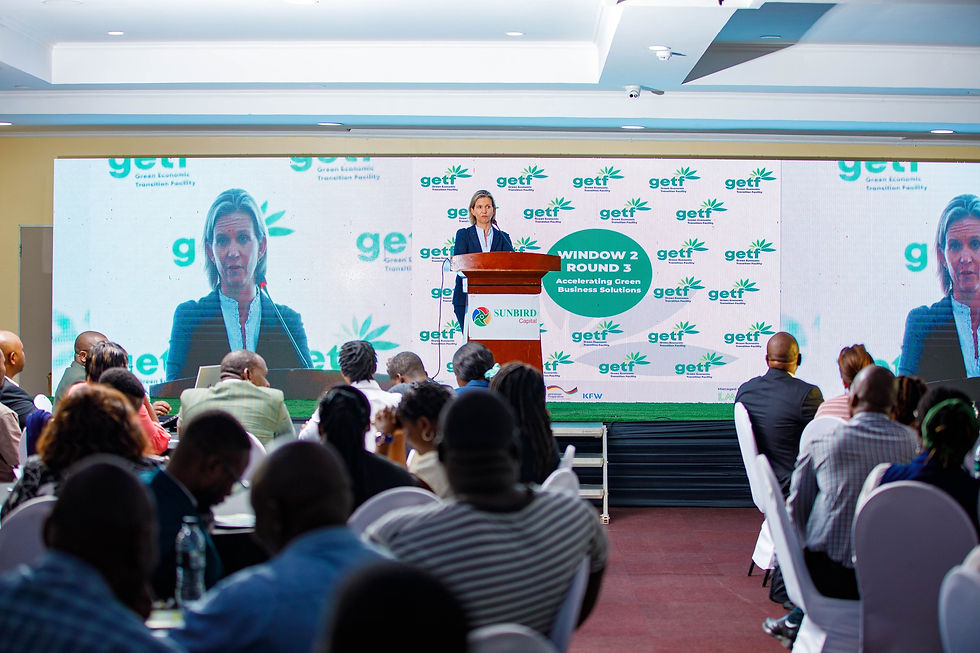
The UNDP RR, therefore, called for collaborative efforts among stakeholders to develop home-grown solutions contributing to national development through responsible investments.
On her part, Daniella Base, KfW Country Director Lilongwe office, made a clear call to action by encouraging applicants to submit bold, evidence-based, inclusive, and commercially viable proposals that address environmental pressure points and demonstrate tangible green innovation, emphasizing Germany's commitment to supporting Malawi's climate action and economic transformation.
“From the first two rounds, we also learned that Malawi’s private sector possesses enormous potential for green innovation. However, we observed a concentration of proposals around a few familiar areas, particularly organic fertilizer production,” she stated.
Learning from Round 1 and 2, Window 2 Round 3 of the GETF has narrowed down to specific focus areas; these are: Waste Management Solutions, Technologically Advanced Soil Conservation, Biodiversity Conservation and Restoration, Green Financial Solutions, Crop and Seed Technologies, Livestock and Fisheries Technologies, Eco-Tourism and Nature-Based Enterprises, Digital Green Solutions, E-Mobility and Green Transport.
Funded by the Germany government through KfW Development Bank, round 3 of Window 2 of the GETF under the theme accelerating green business solutions, is likely to attract a record number of applications judging from the over 300 patrons who attended the recent launch event.
According to Tambulani Chunga, GETF Project Manager, the Expression of Interest process will close on January 10, 2026.
After the submission of Expressions of Interest, successful applicants will be invited to submit formal proposals which will then be evaluated by an independent Green Investment Committee (GIC), thereafter, all applicants will be notified of the GIC decision.
“The GIC is then followed by a Contract Negotiation process to develop mutually agreed milestones to guide the grant disbursements,” says Chunga.

The GETF provides success applicants with on-demand technical assistance and matching grants of between $40,000 and $300,000. According to GETF eligibility criteria, a lead applicant must be a private for-profit company or financial institution operating or willing to operate in Malawi; and companies should not match GETF funding with another donor’s financing.
“Applicants must demonstrate their capacity and sound financial performance and clear corporate governance,” state the rules.
Further, applicants are required to demonstrate the ability to deliver environmental and social benefits and it is a must to provide information on how projects might affect the environment, and how to mitigate negative effects.
Applicants should also “ensure minimum of 30% inclusion of women or youth in the project as producers, suppliers.”
The GETF Window 2 Round 3 is KfW’s final round under the current facility which has already supported two other rounds supporting 11 pioneering green business solutions, out of which 4 have already started receiving financing support which are already delivering early noticeable impacts such as nearly 3,500 low-income households have already started accessing green solutions and over 50 permanent jobs have been created already under these window 2 first round 4 projects which are all currently in early stages of implementation.
GETF Admin